
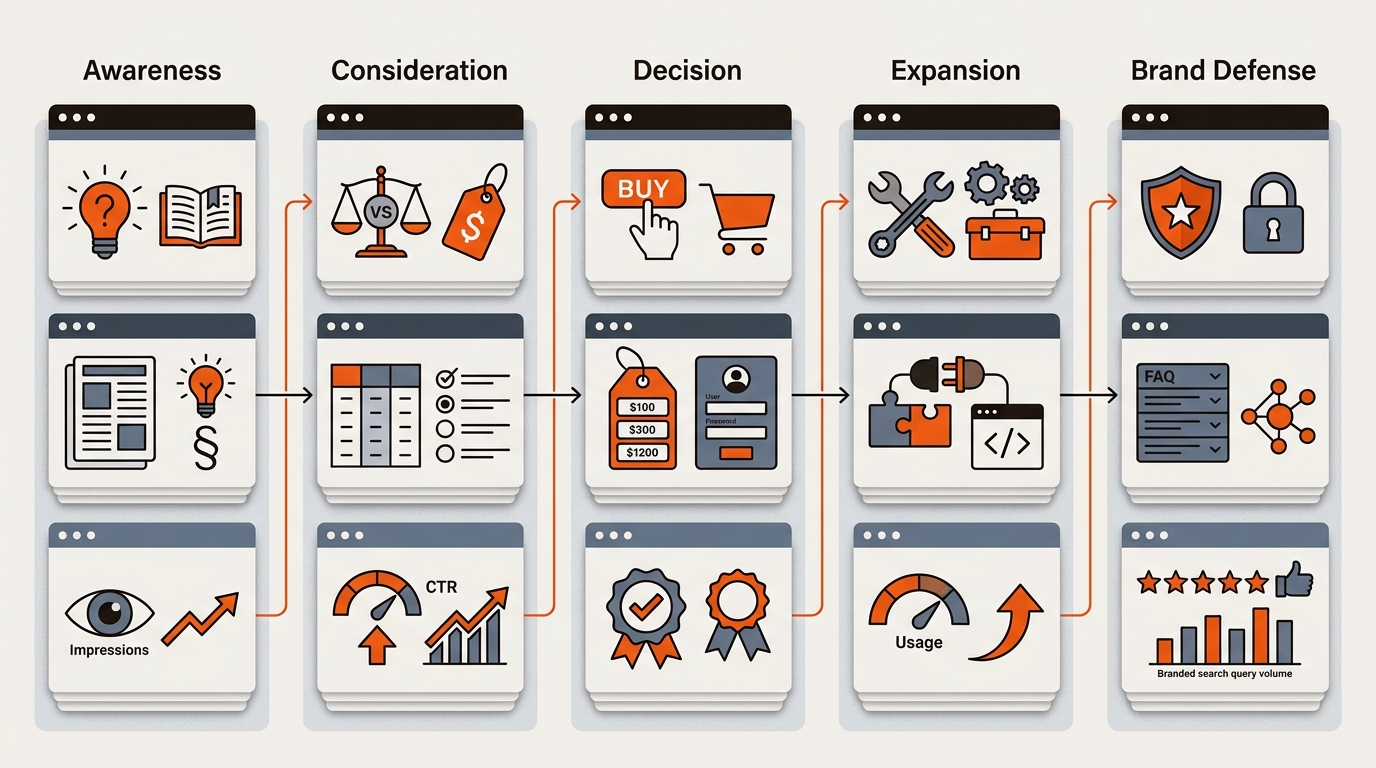
Short answer: SEO spans the entire funnel: awareness (informational intent), consideration (comparison intent), decision (transactional intent), and expansion/retention (post-purchase intent). The right part of the funnel for SEO is the stage matched to the query’s intent and SERP features. Map keywords to stages, build matching page types, and track stage-specific KPIs. For fast pipeline, prioritize BOFU and MOFU first.

Treating SEO as only TOFU shows up as high traffic and low pipeline. Example: publish 50 listicles and definition posts in a quarter, grow organic sessions 70 percent, but demos from organic rise from 28 to 34. Average session depth stays at 1.2 pages, scroll depth is shallow, and pricing or integration pages see little flow from blog landings. You also invite cannibalization by repeating broad topics, slow the site with bloated templates, and train leadership to expect volume over revenue. The fix starts by measuring intent mix and holding TOFU to an explicit downstream target.
Rank by matching funnel stage to user intent, SERP features, and the right page types. Intent fit improves CTR, on-page engagement, and AI citations because your answers line up with how engines assemble overviews and PAA.
caption
Use Ahrefs or SEMrush to label intent at the keyword level, validate SERP features, and group by stage. Then ship pages that mirror winning formats on page one, not just topics your team prefers to write.
For deeper context, see How To Bring Organic Traffic To Your Website.
Stage to intent map, with KPIs that expose movement: TOFU problem queries feed primers, checklists, and calculators. Track engaged sessions, email signups, and assisted trials. MOFU solution and category queries feed comparisons, integration hubs, and ROI pages. Track CTR from TOFU to MOFU, PQLs, and sourced trials. BOFU vendor and transactional queries feed pricing, demo, security, and migration content. Track demo or trial conversion rate by landing page and influenced revenue. Post purchase queries feed docs and troubleshooters. Track case deflection and expansion signals. Diagnostics: if comparison pages drive under 1 percent demo CTR or pricing exits exceed 70 percent, rework intent fit.
Ship BOFU/MOFU first, wire TOFU to them, and measure by stage-specific KPIs. A small growth team can start moving pipeline by sequencing work like this:
• Build a 30-keyword BOFU/MOFU shortlist in Ahrefs with KD < 25 and clear commercial intent. Draft product, pricing explainer, vertical pages, and 2–3 “X vs Y” pieces. Use Screaming Frog to ensure those pages resolve fast and are indexable.
• For each BOFU/MOFU page, create 2–3 TOFU support posts that answer adjacent questions and internally link down. Use GSC to monitor queries sending impressions and refine H1/H2 to match wording in PAA.
• Add FAQPage and Product schema where relevant, and submit via GSC URL Inspection for faster indexing. Track trials, demos, or ATC to trials in GA4 with clear page_group = stage.
Tradeoff: heavy BOFU focus caps top-line traffic and long-term brand search. As a starting point we suggest 40% BOFU, 40% MOFU, 20% TOFU in the first quarter, then expand TOFU once pipeline stabilizes.
On Monday, tag your corpus by intent and wire pathways. Step 1, in a sheet, export top 200 organic landing URLs with sessions, conversions, and bounce. Assign stage intent and note next best MOFU and BOFU targets. Step 2, in analytics, create landing page groups and segment goal completions by stage. Step 3, add two contextual links and one mid article CTA from each top TOFU page to the mapped targets. Step 4, instrument click events on CTAs. Step 5, fill gaps with three BOFU assets and two integrations. Timebox the audit to two hours and review weekly.
You need pages mapped to each funnel stage, drafted in your brand voice and published when you approve. Mergeflo is an autonomous SEO + AEO content engine: it finds gaps, drafts articles with FAQ schema and suggested internal links, and publishes what you approve to Webflow. It measures citation share across ChatGPT, Perplexity, and Gemini, then ships fixes that close gaps by stage and intent.
Start with BOFU and MOFU that mirror commercial intent and weak competition. Use Ahrefs to find KD < 25 queries with pricing, tool, and comparison modifiers. Validate page-one formats and SERP features, then ship those page types before scaling TOFU. Pipeline lift comes after the pages are indexed and ranking; there is no fixed timeline.
Tag each URL with a stage in your CMS or analytics (page_group = TOFU/MOFU/BOFU/EXP). In GA4, build explorations by page_group and add conversion events tied to each stage (trial_start, demo_request, doc_view). In GSC, map queries to pages and confirm the intended stage is actually winning impressions.
AEO expands impact across stages because AI Overviews and chat answers aggregate informational, comparative, and product facts. Add FAQPage, Product, and HowTo schema to eligible pages, keep answers concise near the top, and structure bullets for extraction. Track citation share in ChatGPT and Perplexity to see where you’re being quoted.
Give each intent a distinct target: one keyword, one URL, one job. Use “topic: X vs Y” for MOFU comparisons, “what is X” for TOFU, and “[product] for [ICP]” for BOFU. In Screaming Frog, flag duplicate titles/H1s and merge overlapping posts. Consolidation usually improves rankings within 2–3 crawls.
