
Automation can turn a single seed topic into a publishable map of intents, but only if you control what the system optimizes for. Automated keyword research should reduce time-to-publish, prevent cannibalization, and align with business fit. If it only dumps a CSV of ideas, it creates rework. This playbook shows the checks that keep automation useful.
Use automated keyword research to structure clusters, not just lists. Tie every batch to search intent, internal links, and a draft plan the CMS can ship.

Automated SEO workflows for startup efficiency
Founders and lean marketers who need reliable inputs for briefs without hiring a research team. If you ship content weekly, run AI in your stack, and want autonomy from agencies, this is for you. Technical co-founders who prefer pipelines over checklists will find the operator detail they can put into production.
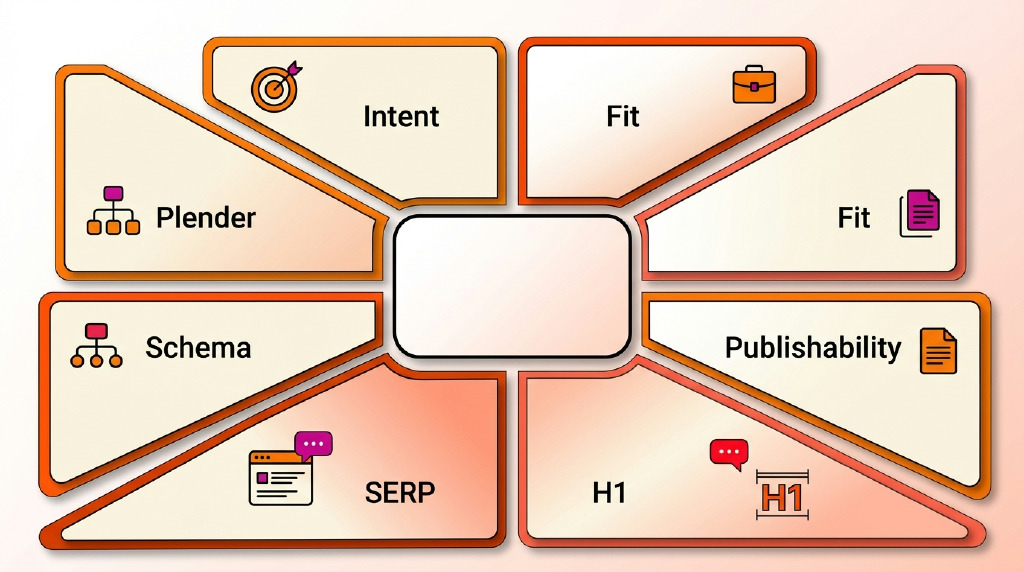
A good system prioritizes by intent, business fit, and publishability, not just volume. Require: intent labels per term, a parent topic, a suggested H1, and draft slug formats. Add flags for SERP features, question queries, and proven keyword expansion sources.
Design outputs that support both Google and AI answers with clear question phrasing and definitions. Many teams chase model-specific prompts and overlook Answer Engine Optimization and Generative Engine Optimization; make space for both in your artefacts.
Can I use ChatGPT for keyword research
Trust semantic proximity and SERP shape; double-check any single-source difficulty or volume. Use modifiers to uncover low-competition long-tail variants and product-led questions. Validate competition with manual SERP sampling and title patterns across page one. Cross-check head terms with independent pulls from automation guides you can verify.
Treat the keyword list as hypotheses; the SERP is the lab where you validate intent and feasibility.
Favor patterns you can see: repeated listicles vs deep guides, docs vs blogs, and whether commercial pages win informational queries. Treat any difficulty score as a directional signal until the SERP confirms your angle can stand out.
Intent clusters turn lists into briefs and safeguard against overlapping posts. Group terms by do, know, compare, and navigate, then map one canonical to each. Use subheads to capture profitable, low-competition angles and adjacent questions inside one piece instead of spinning separate posts.
Build internal links that reinforce topical authority inside the cluster, and place FAQs that mirror People Also Ask phrasing. This structure keeps your architecture clean and reduces internal competition while making updates easier across related nodes.
Automated SEO workflows that prevent rework
Automate for coverage, then validate for fit and feasibility. Skim top results for author type, content depth, and structured answers. Spot structured data opportunities and add schema where relevant to guide rich results. Avoid thin variations by consolidating near-duplicates into stronger canonicals to reduce discovered-but-not-indexed risk.
Treat AI outputs as drafts that speed ideation. Store sources in your research sheet and surface citations in briefs so an editor can verify claims later without rework. That habit also supports AEO when you phrase answers cleanly with sourceable definitions.
Most guides to automated keyword research stop at the export and never describe the validation loop that trims the noise. Agency blogs cover tools and skip the handoff artefacts a two-person team can maintain. This article centers on the weekly routine, audit checks, and the publishable outputs that make automation dependable.
If the export cannot become a brief in minutes, it will stall your queue. Use this table to judge outputs before you adopt a workflow.
| Output Element | What Good Looks Like | How To Verify | Failure Mode |
|---|---|---|---|
| Intent Label | Clear do/know/compare/navigate | Matches top SERP content type | Mixed intents in one cluster |
| Parent Topic | Single canonical target | H1 and slug align | Orphaned subtopics |
| SERP Features | Notes on snippets, PAA, videos | Manual spot check | Ignoring universal results |
| Draft H1 and Slug | Readable, keyword-aligned | Fits CMS pattern | Slugs collide across posts |
| Questions Captured | PAA and long-tail included | Align with FAQs | Thin Q&A duplication |
| Schema Hints | Eligible types listed | Can map to CMS | Missed rich result chance |
For a lightweight cross-check of your automation logic, run a small batch with a separate pull that follows a repeatable step-by-step approach and compare overlaps and gaps before you scale.
This guide's framework, the Intent Lattice Framework, turns scattered terms into connected publishable nodes. It maps each cluster to a lattice node with one canonical, supporting subheads, FAQs, and internal links to neighboring nodes. Apply it by assigning one action page for do queries, one explainer for know queries, and one compare page for versus queries. The tradeoff is fewer standalone posts and more depth per node, which yields clearer signals. Failure modes include over-splitting thin variations and overlooking navigational intent that deserves its own route.
A single seed term can feed a realistic weekly plan when you cap scope and enforce artefacts. Say you start with automated keyword research and pull 40 suggestions, so a filter that keeps only do, know, and compare terms keeps 40 x 1 = 40 intact. Suppose you cluster them into 5 groups, so assigning 1 canonical and 3 subheads to each makes 5 x 4 = 20 planned sections. Say you choose 3 clusters to publish this week, so drafting briefs with 1 H1, 5 H2s, and 4 FAQs each makes 3 x 10 = 30 elements. Add the steps: 40 + 20 + 30 = 90 elements.
If most terms point at the same SERP, merge them or you will compete with yourself. Consolidate into one guide and redirect weak variants. For crawled-but-not-indexed and discovered-but-not-indexed, strengthen the page with unique subheads, internal links from relevant posts, and helpful schema such as FAQ or HowTo where it fits.
A common failure scenario: a two-person team imports a thousand terms and tries to assign every variant to a separate draft. They stall on approvals and indexing lags. Cap throughput to a few clusters a week, enforce one canonical per intent, and keep a running backlog that absorbs variants as subheads or FAQs.
There is always a tradeoff between speed and depth. Many thin articles ship faster but fragment authority and stretch review capacity, while fewer complete pages demand stronger briefs and editing. Pick the line your team can sustain for months.
Most content ideas never become indexed assets because teams lack a routinized brief. Automated keyword research is only useful if it shortens the path from idea to a shipped page that can rank and earn AI citations. A simple, repeatable artefact keeps your cadence steady when you run lean and primes the next section: turning outputs into briefs.
Every cluster becomes a one-page brief your CMS can load. Include H1, URL, intro angle, H2 outline, FAQs tailored to your niche's zero-traffic gaps, internal link targets, and schema instructions. Add an AEO note that defines the concise answer you want quoted, and a GEO note that clarifies how the piece should surface in generative summaries.
Only AI-citable content; no manual code or CMS integration templates needed. Tooling can assist, but the shipping unit is the brief that a human approves. Use AI to draft alternative H2s and identify missing questions, then check the live SERP and your analytics to validate intent alignment.
How ChatGPT fits inside keyword research
Mergeflo is an AI search visibility platform for startups seeking to rank on Google and earn AI citations. Mergeflo helps teams turn research into publishable briefs, add schema, and track citations without agency overhead.
Automation works when it outputs publishable briefs, enforces intent, and supports AEO. Treat the list as hypotheses, the SERP as validation, and the brief as the shipping unit. Keep your lattice tight, your schema clear, and your cadence steady. Ship clusters and avoid orphans to turn traffic into outcomes that your product and sales teams can use.
For deeper context, see Best AI SEO Tools for Startups (2026): Platforms Compared.
Pair clustering with manual SERP sampling and keep one canonical per intent. Use subheads to absorb near-duplicates. Add structured data and internal links to differentiate pages, and avoid creating multiple posts that answer the same question. Write FAQs that mirror real queries and show concise answers, then fold variants into those sections.
Use models for expansion and grouping while the live SERP is the final arbiter. Prompt for variants and questions, then validate titles and page types you see ranking. Keep a research log that stores sources and decisions, so editors can cross-check claims and reuse snippets across briefs without redoing discovery.
Publish on a cadence you can sustain as briefs, drafts, and updates. Consistency beats bursts that overload review and stall indexing. Tie each week to a cluster so you build topical authority and avoid one-off posts that lack internal links or schema support. Make space for updates to keep clusters cohesive.
Consolidate thin pages that chase the same intent and strengthen the canonical with unique subheads, richer answers, and clear internal links. Ensure the page serves a single intent and implements schema that helps systems parse the content. Submit the canonical and keep feeding it signals from related posts within the cluster.
