
Short answer: To learn SEO as a beginner, follow a 30-60-90 day plan: master crawling/indexing basics, ship a tight keyword cluster, publish a small set of optimized pages, and track with GSC and Ahrefs; add AEO tasks to earn AI Overview and LLM citations. Use Screaming Frog for audits, ship weekly, and iterate from ranking and citation data.
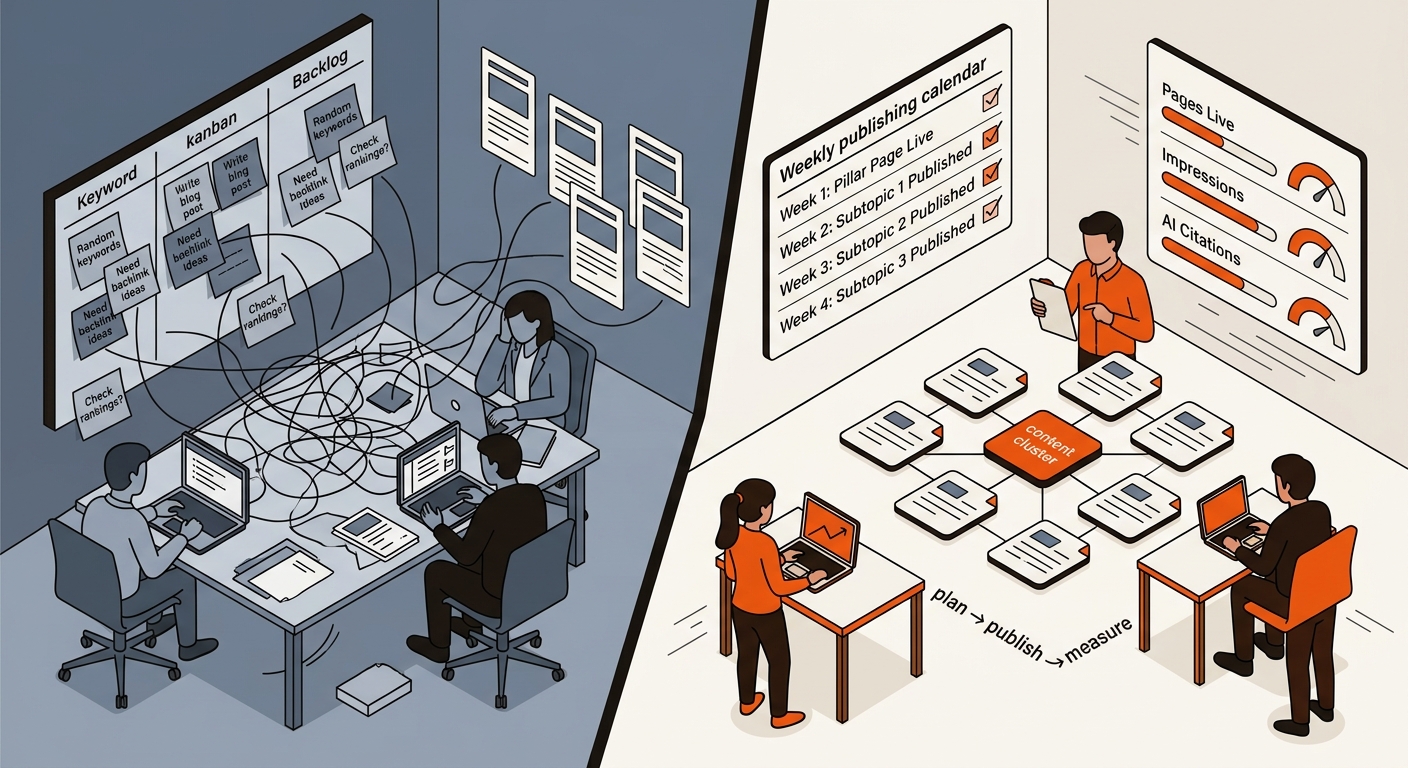
Beginners stall because they study tactics without shipping a measurable project. Watching courses creates knowledge; only shipping pages creates data you can act on.
For a small growth team, a scattered backlog kills momentum. You need one cluster, one publishing cadence, and one scoreboard. Aim to have real pages live within the first month.
Treat learning SEO as a project: ship a focused cluster and measure what moves.
• Days 1-30: Fundamentals + first cluster. Run Screaming Frog on your site to learn crawl issues. In Ahrefs or SEMrush, pick a parent topic with KD under 20 and 15-30 long-tails. Draft briefs that include title, H1, 3-5 H2s, FAQs, and internal link targets. Publish your first pages. Add FAQPage schema and clean internal links.
• Days 31-60: Depth + AEO. Expand the cluster. Add AEO tasks: concise Short Answer blocks, comparison tables, clear FAQs, and entity-rich intros. Track AI citations weekly by checking Perplexity and Gemini answer panels for your brand and page titles. Tighten topical coverage where you’re absent.
• Days 61-90: Feedback and expansion. Use Google Search Console (GSC) to find queries where you’re 8-20 average position. Add sections answering those queries directly. Consolidate thin pages. Start a second mini-cluster only if the first is showing impressions and early clicks.
Anchor your practice in real use cases. If you sell B2B SAAS, align your first cluster to solution-aware queries, then layer in SEO strategies for SAAS companies for deeper relevance. This keeps your SEO learning path revenue-adjacent.
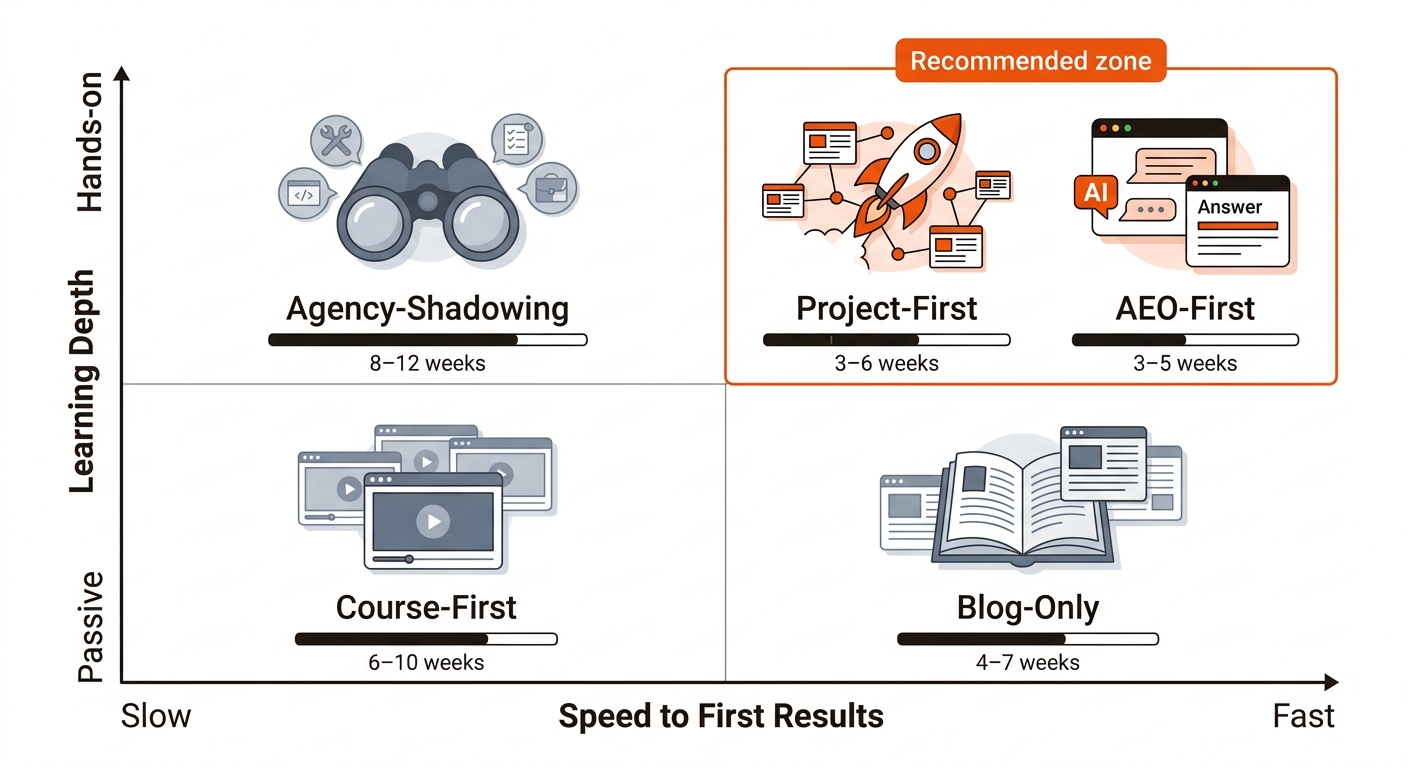
Hands-on shipping beats passive consumption when the goal is ranking and citations.
caption
Repeat a simple weekly loop: plan, ship, audit, and adjust from data.
• Plan: Choose 2-3 keywords from your cluster with KD under 20 and intent that matches your product. Draft briefs with entities (use Google’s NLP or Clearscope), one comparison table, and 4 FAQs.
• Ship: Publish on a steady weekly schedule. Use consistent URL slugs, clean H2/H3s, and 2-3 internal links per page. Add FAQPage and Product schema where relevant.
• Audit: Crawl with Screaming Frog to fix non-200s, missing titles, and duplicate H1s. Check GSC for coverage and indexing.
• Adjust: Use Ahrefs “Top Pages” to compare title tags and H2 phrasing vs. top 3. Add a Short Answer block targeting the exact query. For links, sanity-check with how many backlinks you actually need based on SERP link profiles.
Pages that ship schema, tight internal links, and a clear Short Answer give Google and answer engines more to work with.
Operational tradeoff: volume vs. depth. Many low-quality pages slow indexing and dilute internal links. A smaller set of strong, interlinked pages builds authority in a narrow topic.
Tie learning to KPIs you can move in weeks.
• First: new pages discovered in Search Console and no critical crawl errors in Screaming Frog.
• Next: impressions appear for the cluster, with several queries per page in GSC Performance.
• Then: long-tail keywords move toward page one and the first clicks arrive.
• Later: a first page-one ranking on a long-tail query, and AI answer checks that show your page cited for brand-aligned questions. There is no fixed timeline for any of these steps.
Track AI visibility directly. Log weekly snapshots of LLM answers for 10 target questions. Record if your domain is cited, which snippet was lifted, and what section it came from (Short Answer, table, FAQ). Adjust structure where citations cluster.
If you want help with this workflow, Mergeflo drafts briefs and articles for your review and publishes the ones you approve to Webflow. Our autonomous SEO + AEO content engine finds gaps, drafts articles with FAQ schema and suggested internal links, and publishes the ones you approve to Webflow. It also tracks citation share across ChatGPT, Perplexity, and Gemini, then ships fixes into your CMS. You get Google rankings and AI citations without hiring an agency.
Good questions compress your learning curve by months.
Plan for 6-8 hours: 2 hours research/briefing, 3 hours drafting/editing, 1 hour publishing, 1-2 hours auditing and measurement. With this cadence, most beginners ship 2 pages/week and see first impressions by week 3-4 on low-KD queries.
You can earn impressions and some long-tail clicks without links if your cluster is tight and technicals are clean. For competitive terms, you’ll need links. Benchmark SERP link profiles in Ahrefs; prioritize internal links first, then pursue 2-3 relevant mentions per month.
Start with crawl/index basics (status codes, robots, sitemaps), then put most of your time into content shipping. Technical fixes unlock indexing; content drives rankings. Use Screaming Frog for quick wins, then focus on briefs, on-page structure, and internal links.
Structure pages for extraction: a Short Answer up top, one dense comparison table, and exactly 4 FAQs. Use entity-rich phrasing and clear headings. Check Perplexity/Gemini weekly to see if you’re cited; adjust wording and add schema where answers are lifted.
Ship a focused cluster, measure weekly, and restructure pages for extraction. You’ll learn faster from a handful of live, interlinked pages than from hours of theory. Keep the scope tight, make the structure liftable by AI, and iterate from the data you generate.
