
Ship revenue pages first; educate after. When you weigh SEO landing pages vs blog posts, launch high-intent landing pages first to capture demand that already exists. Build your solution, use case, industry, pricing, comparison, and alternatives pages, then expand with blogs. If you need a blueprint, study how SEO for startups aligns content to bottom-of-funnel queries.
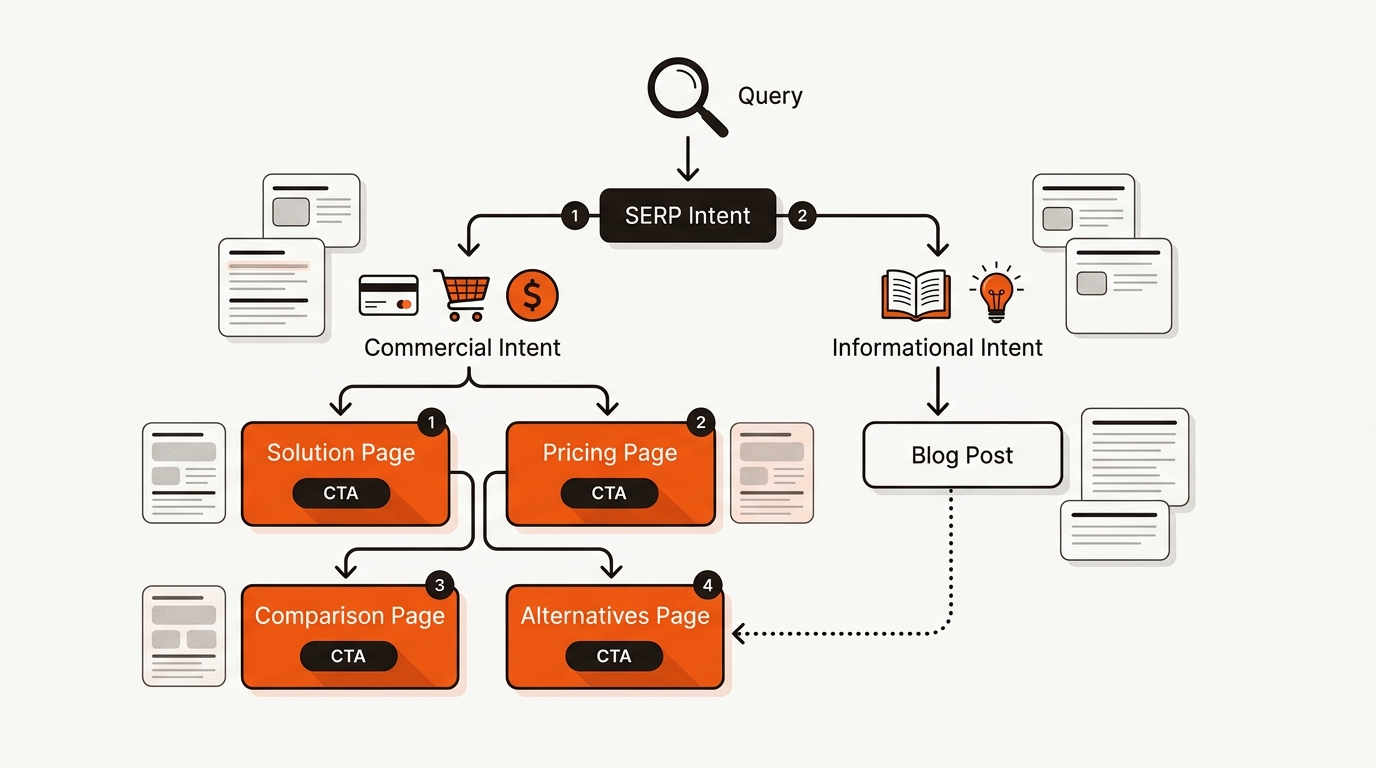
Reference: Ahrefs on search intent, Grow and Convert on landing page vs blog.
Founders default to blogging because content marketing tools sell content marketing. But a startup with 1,180 monthly impressions and 7 clicks needs commercial pages first, solution pages, comparison pages, alternatives pages, to capture demand already searching with intent. Blogs build depth and links after the conversion stack exists. Publishing 20 blogs before a single landing page burns 90 days of founder time on assets that will not pay back for 6 months.
Most SEO guides treat content types as interchangeable. Generic Ahrefs and CXL posts list 'blog vs landing page' tradeoffs without tying them to revenue line of sight or stage. They assume teams have unlimited bandwidth to publish both. For lean startups, sequencing matters more than coverage. The gap is a stage-aware playbook: which 20 pages to build first, which 80 to write later, and how to know when you have earned the right to expand.
Match page types to intent and ship in revenue order. Use this as your publishing filter before you write another post on tips.
Scan modifiers in your keyword list: pricing, cost, vs, alternative, best for, and template signal different formats. Ranking comes from intent-fit first, then depth. Use the table to set your publishing queue.

Build a spine before you build muscle. The 20-Page Revenue Spine is a sequencing model that prioritizes pages with direct dollar visibility. Create solution, use case, industry, pricing, comparison, and alternatives pages, then add a pillar hub to route authority. Use blogs to reinforce topical depth and feed internal links into money pages. Tradeoffs: initial velocity over breadth; avoid thin duplication by differentiating outcomes, proof, and FAQs per page. Failure modes include mismatched SERP intent, cloning copy across pages, and weak hub-and-spoke linking.
• 1 Solution page for the core product keyword
• 3-5 Use case pages mapped to job-to-be-done queries
• 3-5 Industry pages for your top ICP segments
• 1 Pricing page with transparent plans
• 5-7 Comparison pages for top competitors
• 2-3 Alternatives pages covering aggregated demand
• 1 Pillar page that hubs the cluster
• 1 Supportive blog that answers the most-blocking objection
• 1 Case study or proof page linked from all BOFU pages
• 1 Performance or reliability page if relevant to evaluation
A lean team can ship this in 4-6 weeks with a strong brief system. Program briefs from your keyword clusters, reuse a layout framework, and route internal links as you publish. This gets you ranking coverage on BOFU terms before you scale educational content.
Commercial pages win on conversion math. Assume a target keyword with 1,200 monthly volume, KD 28, and that either a landing page or a blog could rank at position 5.
• Landing page CTR at position 5: 5.6% (assumed). Visits: 1,200 x 0.056 = 67/month. CVR: 5.5%. Leads: 67 x 0.055 = 3.7/month. Close rate: 15%. New customers: 3.7 x 0.15 = 0.55/month. If each customer is worth V in MRR, MRR impact = 0.55 x V.
• Blog post CTR at position 5: 5.6%. Visits: 67/month. CVR: 1.6%. Leads: 67 x 0.016 = 1.1/month. Close rate: 10%. New customers: 1.1 x 0.10 = 0.11/month. MRR impact = 0.11 x V.
In this model the landing page brings roughly 5x the customers for the same position. If your own numbers look similar, ship the landing page first and publish the educational cluster next.
Treat money pages like products. Build unique narratives tied to outcomes, load fast, and remove index blockers. Aim for sub-2.0s LCP, compress images, and keep CLS tight to avoid layout shifts. Add social proof near the fold, answer evaluative FAQs inline, and match CTAs to query intent (demo for enterprise, start free for PLG).
Use descriptive anchors to pass topical signals: route 5-8 internal links from relevant blogs and adjacent pages into each BOFU page. Example anchors: workflow automation software, pricing for workflow automation, or Mergeflo vs spreadsheets. Cross-link BOFU pages where evaluation paths intersect, then point everything to a clear pillar hub.
Use a hub to organize the cluster so crawlers and users find depth. If you need a template at scale, see our startup SEO guide and validate technicals with GSC and Screaming Frog. To earn citations in AI Overviews, structure crisp answer blocks, add clear pros/cons, and mark up FAQs with schema. For credibility, align copy to real outcomes, show numbers, and name the stack.
Operational tradeoff: speed vs depth. Publishing 8 thorough pages that match intent and convert beats 20 thin stubs that stall in page 2 limbo. At 200+ URLs, indexing lag compounds if internal links are weak and templates are near-duplicate; consolidate overlapping pages and strengthen the hub.

Get help with the sequence.
• Explore the AI SEO platform for startups for briefs, outlines, and suggested internal links.
• If you’re replacing headcount or agencies, see our SEO agency alternative for startups.
• When you’re ready to scale, build the 20-page conversion stack.
If a query can buy, meet it with a page that sells. Use SERP intent to pick format, build the 20-page spine, and route internal links from blogs into your BOFU pages. That is how you rank and convert with fewer pages. Mention SEO landing pages vs blog posts in planning meetings so your team defaults to the format that drives revenue now.
Ship in this order to capture demand before earning breadth.
1. One canonical solution page that names your category and primary outcome.
2. One pricing page with stage-based plan ranges that match founder buyer intent.
3. Three comparison pages targeting top-3 competitor queries (vs X, vs Y, vs Z).
4. Two alternatives pages targeting 'X alternative' searches at higher intent.
5. One pillar page that anchors the cluster and earns links from blogs.
6. Three founder-pain blog posts that link upward to canonical and pillar.
7. Three execution blog posts that demonstrate operating depth.
8. One refresh review at week 8 before scaling to the next 20 pages.
SEO landing pages vs blog posts covers the structural work of the article above: the page inventory, the workflow that keeps it shipping, and the measurement loop that confirms it's working. The sections preceding this FAQ describe each part in detail.
A founder or growth lead owns the strategy; one operator runs the weekly workflow. Two part-time hours per week is enough at the early stage. Outsourcing the whole stack to an agency is the common failure mode, agencies optimize for their own retention, not your ranking goals. Mergeflo drafts the work for your review, so you keep strategic control.
Direct-intent queries can rank inside 30, 60 days when the page inventory and internal linking are sound. Broad pillar topics typically need 90, 180 days to compound. The variance is mostly explained by content velocity and how long it takes Google to discover and rerank new pages.
Most early-stage teams spend $1, 3k/month total when running SEO landing pages vs blog posts in-house. Tooling alone runs $200, 800/mo. Agency retainers start around $3k and climb fast. Mergeflo is software, not an agency: it researches and drafts, and your team approves what publishes.
Software gives you dashboards and recommendations. The work, research, briefs, drafts, publishing, refreshes, is still on you. An execution platform runs the work and ships the page. Software is rented expertise; execution is rented labor. Landing pages and blogs are the inventory; software optimizes how they rank. You need both, but never pick a software before the page sequencing is locked.
Mergeflo researches topics, writes briefs and drafts in your brand voice, adds FAQ schema and suggests internal links. You choose the topics and approve each article, and it publishes to Webflow only when you press Publish. For pages losing reach, Mergeflo flags them and writes a refresh brief for you to review.
• SEO for Startups Guide: Build the 20-Page Conversion Stack
• Startup Blog SEO Architecture That Compounds Growth
