
Short answer: The difference between SEO and technical SEO is that SEO covers content, intent match, and authority to win queries, while technical SEO focuses on crawl, render, speed, and index controls. Treat technical SEO as the infrastructure for discovery, then use content and links to capture relevance and authority.
Most teams either ship content on a broken foundation or tune the foundation with nothing worth indexing. If your SPA blocks rendering or your canonicals point to paginated URLs, Google will stall discovery. You can publish every week; missing basics means index volatility and soft caps on ranking.
Google warns that blocking critical resources can prevent Googlebot from seeing your page as users do, hurting indexability and ranking potential. Search Essentials
A small team must choose sequence. Prioritize index coverage, Core Web Vitals, and schema matched to your top clusters. Once stable, map content to search intent, tighten H1–H3 structure, and route internal links to conversion pages. The difference between SEO and technical SEO shows up in what blocks velocity vs what wins queries.

Conflation shows up when a content calendar drives priorities while crawl errors and render gaps sit unscored. Example: 100 URLs with soft 404s, 12 templates missing canonicals, and three hubs with orphaned children compete with a product led topic cluster. Fix the queue: create two swimlanes, rank drivers and indexability blockers; score each item by pages affected, risk, effort, and required owner. Set a five day SLA for blockers. Bundle work by template to cut deploys. Validate with spot checks and a fresh crawl, then release. This keeps writers shipping while infrastructure removes hidden caps on discoverability.
Technical SEO enables discovery; content and authority win queries. The table clarifies ownership, tasks, and how each drives rankings and AI citations so you sequence work correctly.
Comparison of SEO vs Technical SEO Responsibilities and Outcomes
Reference: public pass rates and methodology for Core Web Vitals are tracked in the HTTP Archive CWV report.

For deeper context, see How To Redesign Your Website Without Losing SEO Rankings.
Tie technical guardrails to content throughput so you stop publishing into a crawl hole. Run weekly loops: validate indexation on new URLs in GSC, enforce schema templates, then publish clustered content with internal links to money pages. Track CWV by template and query movement on target URLs to confirm fixes translate into visibility.
Mergeflo is an AI search visibility platform for startups. It is an autonomous SEO + AEO content engine that finds gaps, drafts articles with FAQ schema and suggested internal links, and publishes the ones you approve to Webflow. It tracks your Google positions and, on paid plans, checks whether ChatGPT, Gemini and Claude mention your brand. If you are mapping schema to content clusters, see our take on structured data for SEO to align markup with AI citation patterns, not just blue links.
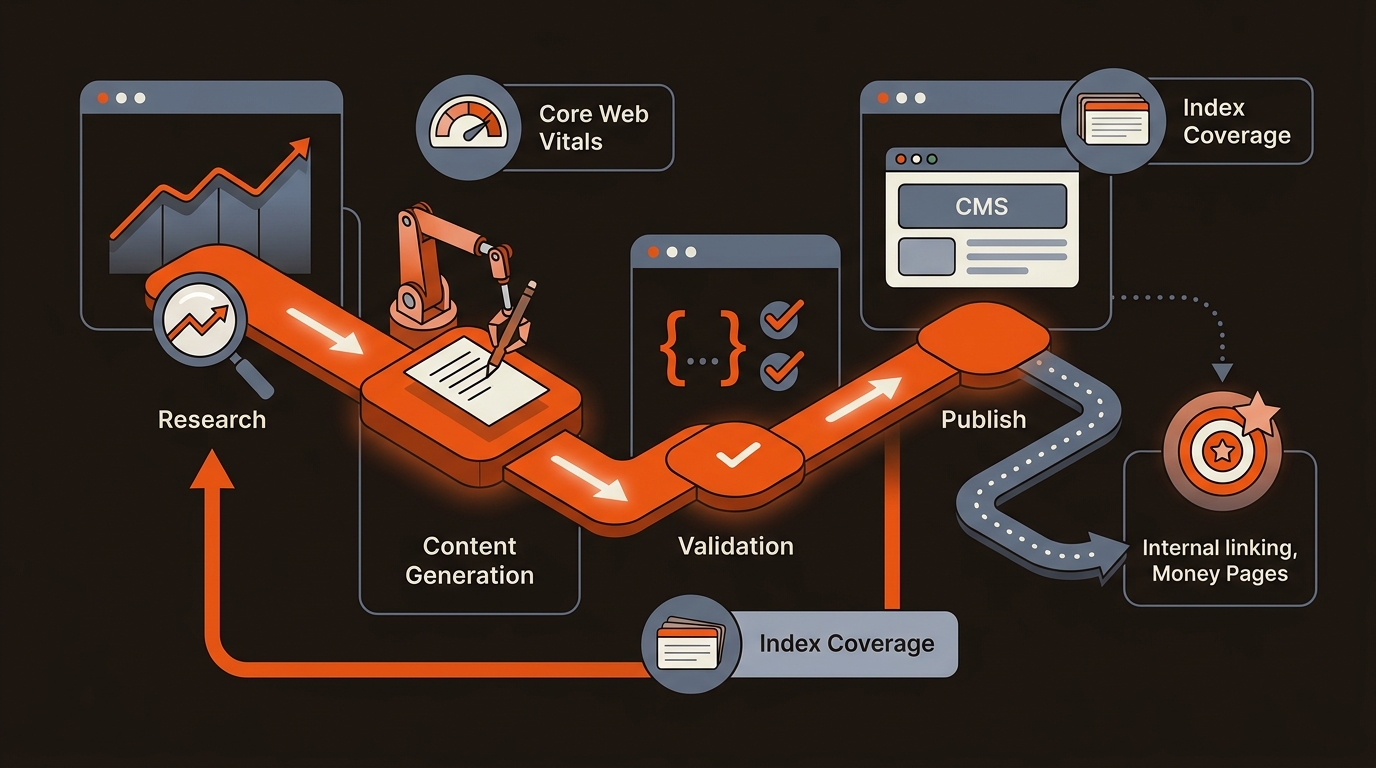
Turn concepts into repeatable work by splitting pipelines in your project tool. Create SEO Strategy and Technical SEO with distinct owners, statuses, and SLAs. Strategy items include intent, primary query, target URL, required internal links, and a brief. Technical items capture template, environment, affected URLs, acceptance tests, and rollback. Wire automations in your build pipeline: auto link PRs, trigger a headless render and Lighthouse on deploy, and re crawl high value pages. Pilot with 50 URLs. Definition of done includes indexed, passing Core Web Vitals thresholds, 200 responses, no blocked resources, and linked from at least two relevant pages.
You need a technical baseline before volume. Ship a correct robots.txt, an XML sitemap, working canonicals, and pass Core Web Vitals on your templates. Once index coverage is clean and rendering verified, focus most of your effort on keyword-mapped content and internal links. That cadence compounds rankings and citations.
Track index ratio (indexed vs submitted), crawl rate patterns in GSC Crawl Stats, CWV pass rate by template, and schema validation plus rich result impressions. Pair this with query-level gains on target pages to confirm technical fixes translated into visibility, not just green lights. If queries stall, reassess intent match.
Give a growth lead the SEO roadmap and measurement, a developer 4–6 hours/week for templates and performance, and a strategist/writer for mapping and publishing. The SEO lead sets controls (canonicals, sitemaps), the dev ships them, and the content owner maintains clusters and internal links. Keep a shared weekly checklist.
During migrations, SPA launches, drastic template changes, or when GSC Coverage shows spikes in Excluded/Discovered-Not-Indexed. Also pause to fix when CWV fails sitewide or faceted navigation explodes crawl paths. Stabilize the foundation, then resume content velocity. The difference between SEO and technical SEO is prioritization under risk.
