
Refreshing existing pages is the fastest path to ranking recovery for lean teams. An SEO content refresh targets dormant pages that already earn impressions, rewrites titles to win the click, fixes intent gaps, and strengthens internal links, lifting CTR within two weeks at zero new content cost.
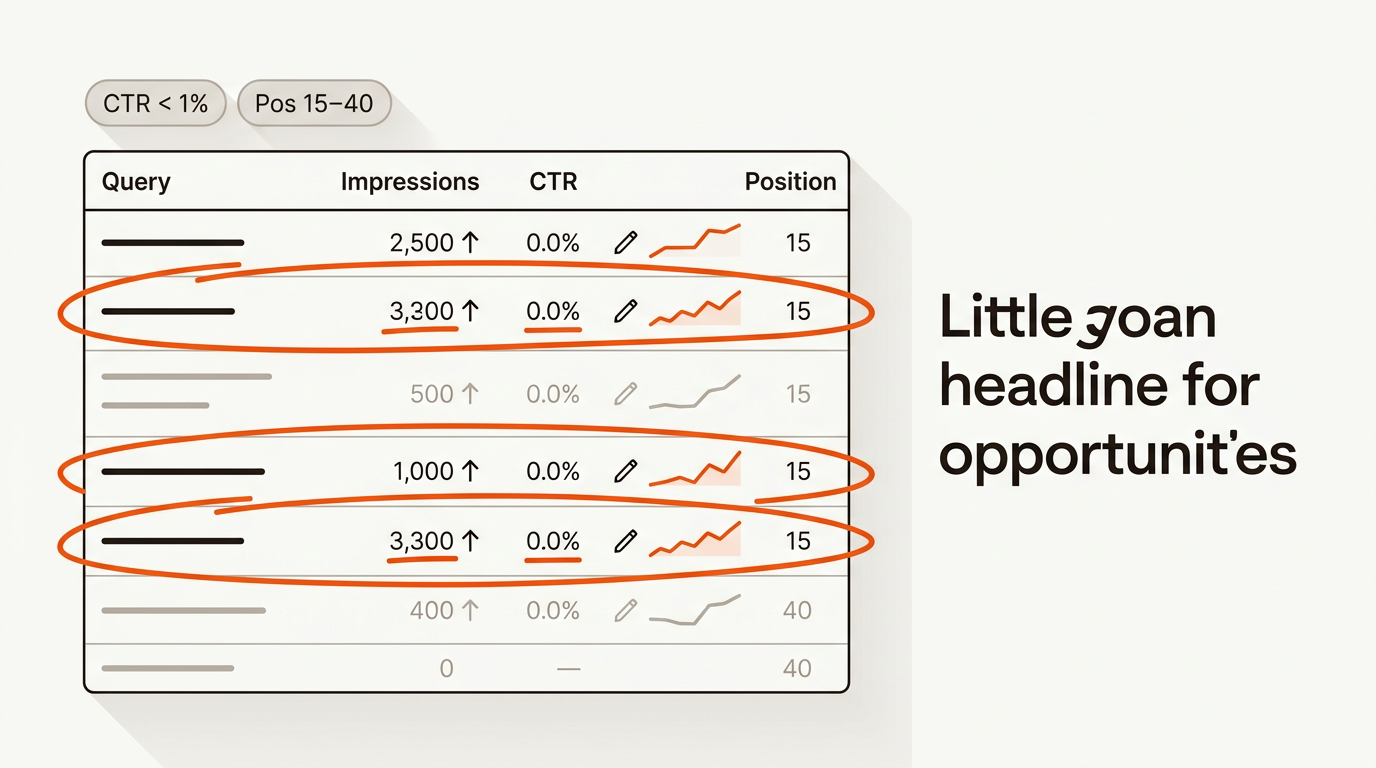
Rankings recover faster than they grow. Pages that already earn impressions but few clicks are the cheapest place to start, because Google already shows them and only the click is missing.
Default SEO content advice from PostHog, Search Atlas, and most agency blogs assumes you have new keywords to chase. They optimize for volume: 'publish weekly to grow.' Few connect GSC's existing data to the refresh decision. The gap is recognizing that pages already on the site hold ranking value that sits dormant. A refresh loop converts that latent inventory into clicks before you spend on the next 10 posts.
You run a 2-5 person growth team and care about outcomes over output.
You publish 10-30 posts a month, know KD from Ahrefs, and see many URLs with impressions but poor CTR. You want a workflow that revives existing assets before committing to new production.
A realistic case: a 3-person growth team with a 2k/month content budget. They ship weekly but most URLs sit on page 3-5. The mandate: recover rankings in 30 days without increasing headcount or spend.
A tight loop beats sporadic overhauls.
1. Identify high-impression, low-CTR URLs in GSC. 2) Benchmark SERP intent and gaps. 3) Rewrite title and intro to win the click. 4) Add missing sections and FAQs aligned to intent. 5) Strengthen internal links and schema. 6) Request indexing and track deltas. If you need execution speed, route eligible URLs into SEO content automation for batch updates.
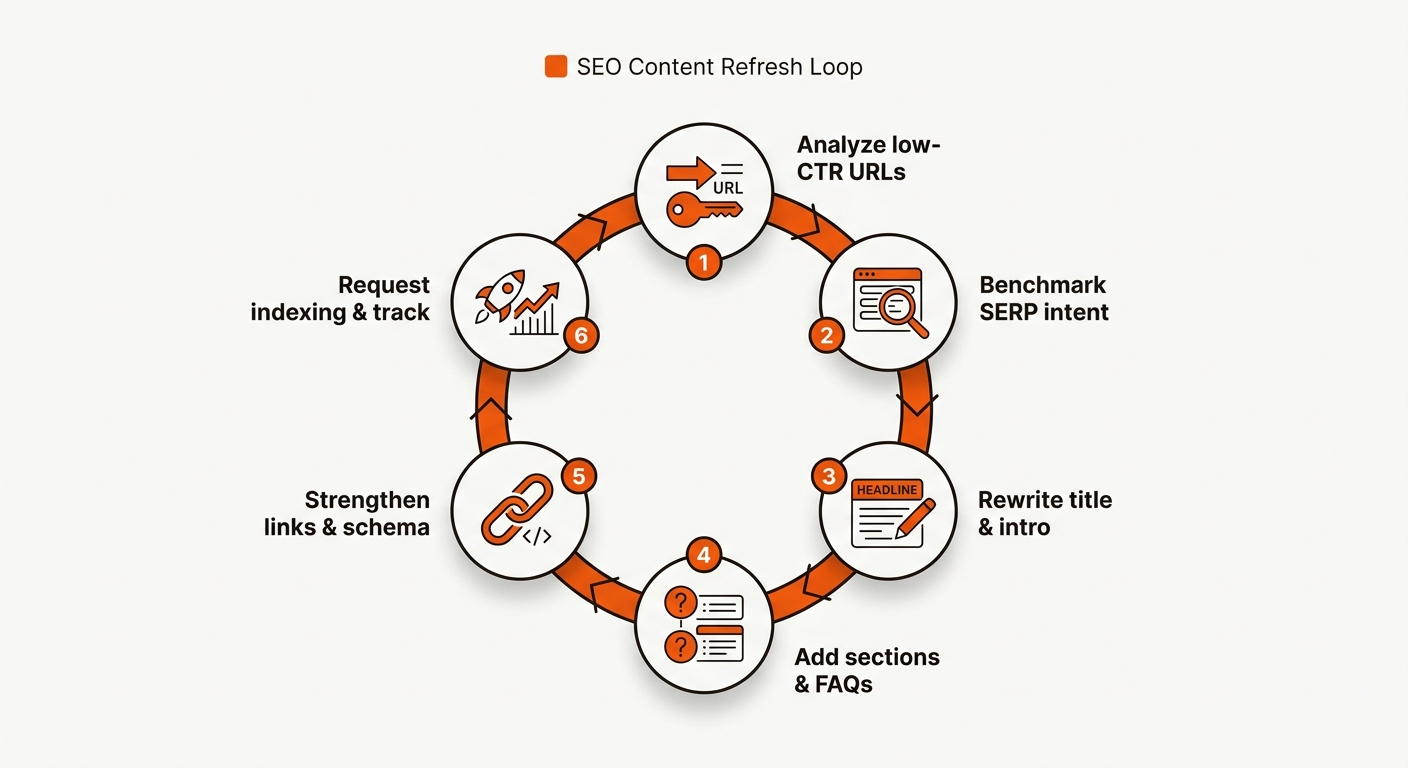
References: Search Engine Land, Animalz.
Titles and first 50 words change CTR more than any other edit.
Map the top 3 SERP intents and mirror the dominant one. Add a concrete promise, timeframe, or quantified outcome. Front-load the main term and remove soft phrasing. Then make the first two sentences answer the core query directly.
Before:
Title: Content Refresh Tips For Beginners
After:
Title: SEO Content Refresh: 6-Step Checklist For Startups
Filling coverage gaps signals completeness and improves dwell.
Scan People Also Ask, the top H2/H3s from ranking pages, and your URL’s Queries in GSC. Add 2-3 sections that precisely answer those questions. Tighten subheads with the primary term where it fits naturally and cite sources updated within the last 12 months.
Use your internal cluster for context. Link to your Startup SEO guide and align your terms with how you group keywords across the cluster. Add a short FAQ at the end with 2-3 concise answers based on PAA and your query data.
Internal links distribute authority to the pages you refresh.
Place 2-4 contextual links from relevant, indexed posts to the refreshed URL using descriptive anchors. Add 1-2 outbound authoritative sources to support claims. Confirm there is only one canonical target for the term to avoid cannibalization. See Google Search Central on canonicalization.
For small teams, create an internal linking queue: every time a page moves into a refresh, allocate two donor pages with traffic.
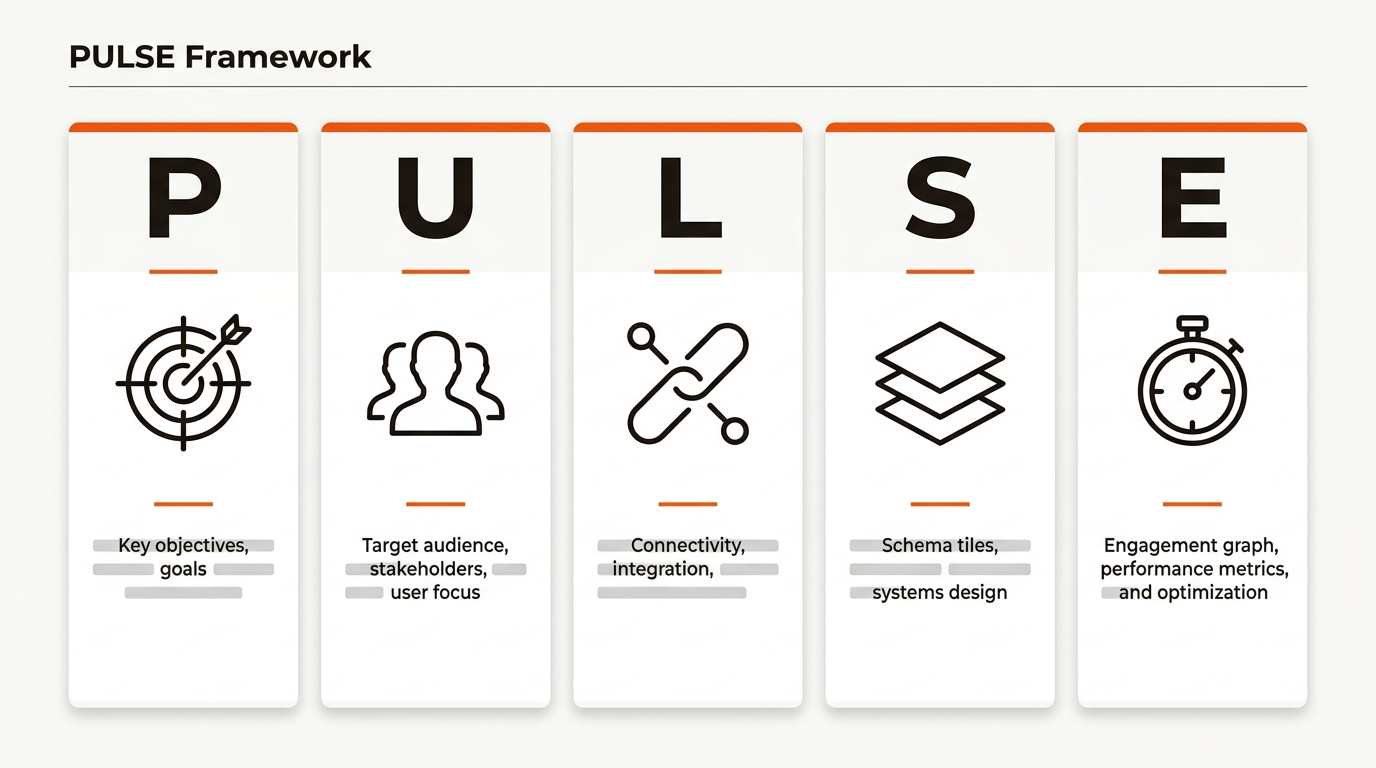
PULSE makes refreshes repeatable across dozens of URLs.
PULSE is a five-step operating model: Probe, Update, Link, Ship, Evaluate. Probe with GSC to isolate high-impression, low-CTR pages and compare your draft to the current SERP to find intent gaps. Update titles, intros, missing sections, FAQs, schema, and citations, staying scoped to the gap so you do not drift from intent. Link refreshed pages into your cluster from authority donors and fix orphaned states. Ship by requesting indexing and logging changes, then Evaluate at day 3, 7, and 14 for position and CTR shifts. Tradeoffs: over-editing can cause intent mismatch; under-editing misses the jump; align scope to SERP depth.
Here is a sample baseline and a target to test against.
Baseline 28 days: 1,180 impressions, 7 clicks, CTR 0.59 percent, avg position 45.5. Actions: title rewrite, add two sections answering top PAA, add three internal links from existing authority pages, request indexing in GSC the same day.
Assume CTR after changes reaches 1.6 percent. If impressions hold at 1,180, clicks = 1,180 x 0.016 = 18.9 (~19). If rank also improves to position ~29 and impressions rise 30 percent to 1,534, clicks = 1,534 x 0.016 = 24.5 (~25).
For a 3-person team, this is a one-day edit cycle per URL. Run ten URLs through this loop and measure each against its own baseline; the real gain per URL, not this example, tells you what refreshes are worth.
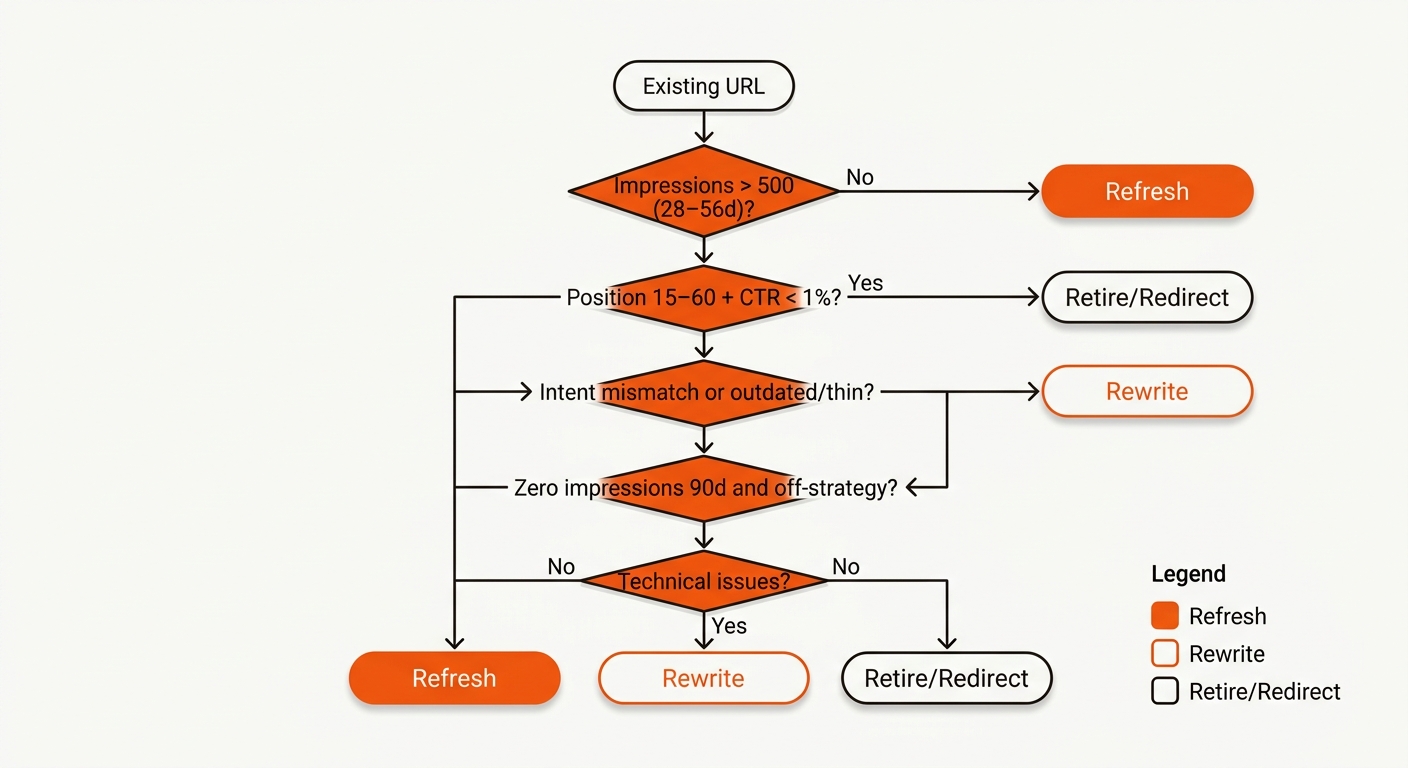
Pick the right intervention to protect ROI.
Near the end of your program, stress-test architecture choices with this overview of startup blog SEO architecture that compounds growth.
• Your autonomous Startup SEO guide for cluster thinking and execution.
• How to measure AI surface wins with AI content visibility tracking.
• Maintain cadence with SEO content publishing consistency.
External: Search Engine Land, Animalz.
Prioritize high-impression, low-CTR pages, fix intent gaps, interlink, and reindex. That is how you recover rankings without new content.
Run the PULSE loop weekly for 10 URLs and track CTR and position deltas. If you want help running this while your team ships product, Mergeflo flags pages losing impressions and writes refresh briefs.
The refresh loop only compounds when the workflow runs weekly. Match approach to founder bandwidth.
The bottleneck is the workflow, not the writing.
SEO content refresh covers the structural work of the article above: the page inventory, the workflow that keeps it shipping, and the measurement loop that confirms it's working. The sections preceding this FAQ describe each part in detail. Plan a fixed weekly slot for refreshes so they do not crowd out new content.
A founder or growth lead owns the strategy; one operator runs the weekly workflow. Two part-time hours per week is enough at the early stage. Outsourcing the whole stack to an agency is the common failure mode, agencies optimize for their own retention, not your ranking goals. Mergeflo drafts the work for your review, so you keep strategic control.
Direct-intent queries can rank inside 30, 60 days when the page inventory and internal linking are sound. Broad pillar topics typically need 90, 180 days to compound. The variance is mostly explained by content velocity and how long it takes Google to discover and rerank new pages.
Tooling alone runs $200, 800/mo. Agency retainers start around $3k and climb fast. Mergeflo is software, not an agency: it researches and drafts, and your team approves what publishes.
Software gives you dashboards and recommendations. The work, research, briefs, drafts, publishing, refreshes, is still on you. An execution platform runs the work and ships the page. Software is rented expertise; execution is rented labor. Software flags refresh candidates from GSC data; the refresh is the writing and re-indexing work. You need both, but the workflow earns the click, not the dashboard.
Mergeflo researches topics, writes briefs and drafts in your brand voice, adds FAQ schema and suggests internal links. You choose the topics and approve each article, and it publishes to Webflow only when you press Publish. For pages losing reach, Mergeflo flags them and writes a refresh brief for you to review.
• Startup SEO Execution: the Weekly Workflow That Ships
• SEO for Startups: What to Do in the First 90 Days
